Bosshire Job Portal
A job portal that has reached 10K+ downloads and 2.5K MAU since its May 2025 launch, with real-time chat and professional networking, built with Flutter on a Golang backend.
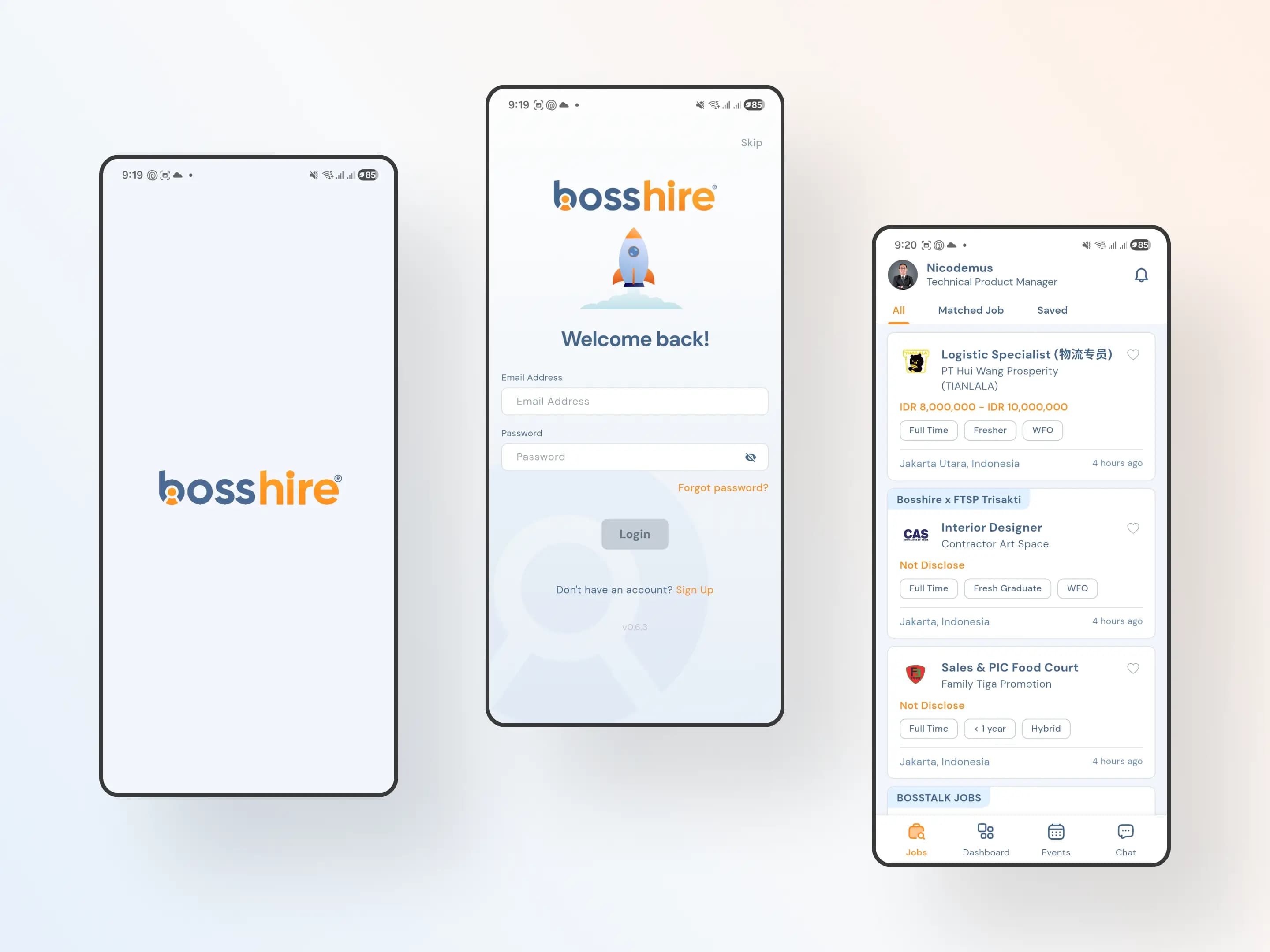
Overview
Bosshire started as an MVP. I built the mobile app and its integrations with the backend. Since its May 2025 launch the app has grown to 10K+ downloads and 2.5K MAU, evolving from a simple job board into a full job portal with real-time networking features. I implemented Clean Architecture with BLoC/Cubit to keep the codebase maintainable as we shipped features.
The problem
The company needed a job portal live on iOS and Android quickly, as an MVP. After the May 2025 launch it grew from a simple job board into a portal with real-time chat and networking, so the code had to stay maintainable while features shipped fast.
Contribution Highlights
Built the MVP from the ground up until it stabilized for thousands of active users.
1. Job matching and Quick Apply
Built job matching and a Quick Apply flow, so users can apply to a job in one tap and get push alerts through Firebase Cloud Messaging (FCM) for new postings.
2. Real-time Live Chat & Networking
Built a real-time live chat and networking feature using WebSockets, letting job seekers and recruiters connect and message each other directly within the app.
3. Event Listings & Registration
Built out the events module showing ongoing job fairs and career events, with in-app registration.
4. Google Login & Release Automation
Added Google Sign-In, and set up Jenkins and Fastlane to automate testing and releases to both the App Store and Play Store, which reduced release time by 20%.
5. Performance, Localization & AI-assisted Development
Profiled the app with Flutter DevTools and Android Studio Profiler to find jank, slow rendering and layout shifts, and optimized local storage use to cut battery drain from background sync and caching. Shipped localization in three languages (Indonesian, English and Chinese). Adopted Claude Code for AI-assisted development, which raised release velocity by 30%.
Architecture and trade-offs
Cubit for state management
I chose Cubit because it needs less boilerplate than full Bloc, which mattered with a strict timeline.
WebSocket chat, a team decision
The team had already picked WebSockets for chat, so I used it and built the mobile side on top.
Golang backend, bug fixes only
The backend is written in Golang. I worked on it only to fix bugs. The feature work was on the mobile app.
Speed over test coverage
I applied TDD to the Cubit logic and helper functions, but the timeline was strict, so I did not always write complete unit tests. I chose shipping on time over full coverage, and that is the main trade-off in this project.
Outcomes
- 10K+
- Downloads
- Since the May 2025 launch. I was the only mobile developer.
- 2.5K
- Monthly active users
- I was the only mobile developer.
- 4.8/5
- Average rating
- Across Google Play and the App Store. I was the only mobile developer.
- 30%
- Increase in feature adoption
- From setting priorities with Firebase Analytics, Remote Config and Crashlytics.
- 20%
- Less time per release
- From the Jenkins and Fastlane pipeline to both stores.
- 30%
- Higher release velocity
- From adopting Claude Code for AI-assisted development.
Key Features
- Job Matching
- Apply Job & Quick Apply
- Google Sign-In
- Real-time Live Chat
- Professional Networking
- Event Listings & Registration
- Push Notifications (FCM)
- Automated Releases (Jenkins, Fastlane)
- Localization (Indonesian, English, Chinese)
Gallery & Mockups
Let's talk
Open to remote full-time and freelance work. I'm based in Tangerang, Indonesia (WIB, UTC+7) and reply within 24 hours.
I also take freelance projects. See freelance work